
Drone
What is Our Man-Machine Relationship in the Future?
Background
Sometime in 2018, I came across a piece of news that Amazon was testing UAVs to deliver packages. I was shocked by the image of massive black machines and started imagining what our sky might look like in the future. This made me wonder about human condition in the years to come: will we benefit from technological development, or will we be forced to feed intelligent machines? Could I create a piece in response to this question?
Approach
"Drone" is a word I borrowed from the honeybee community. A honeycomb is where bees produce and store honey, but I also see it as a symbol of how humans build and organize knowledge. The word “drone” was originally used to describe tasks too dull for humans. This project explores new applications for Unmanned Aerial Vehicles (UAVs) in the realm of touch—specifically, grasping, carrying, and delivering objects autonomously and precisely to designated locations. The original concept featured two UAVs working together to construct the installation, mimicking how honeybees build their hive.


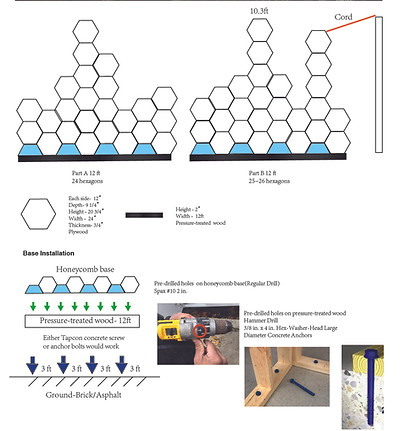
I came up with the concept for the structure design for the installation, LED lighting structure and electricity, and a detailed plan for assimilation, including how to mount this 10ft installation onto the concrete ground.
Although I had no experience with large-scale construction, I carried out the entire project through recalling math calculations, extensive research, and practical advice from suppliers, engineers, and even Home Depot staff.
I found a company in Shenzhen that can manufacture custom parts for the LED light stripes and racks at a reasonable price, which is impossible to do in the US.


I worked with a local woodshop in Aeon to fabricate the hexagonal modules and painted them by hand in the backyard of an Italian contractor's home on a Sunday with his three sons.
Modeling
Installation
(Fun facts!)


Concept
Design

Brainstorm
Fabrication


Regarding the tech part, the original design envisioned two UAVs picking up and assembling the structure, mimicking the way honeybees build their honeycomb. However, I soon realized that the drones available to me weren't capable of that level of precision and strength. I collaborated with engineers from Boston University's School of Engineering to pre-construct the hexagons and use the drones to simulate the building process instead.
I spent a week building the installation by hand, carefully assembling the hexagons and lights to visually present the contrast between monotonous labor and a technologically shaped future. The process was physically intense, but also immersive. I remember one afternoon in particular. I walked across the street to Dunkin’ Donuts. My legs felt numb, heavy due to the two layer of pants. I took off my gloves and thick jacket, sat down with my headphones on, and stared into the void while eating quietly. People were sneaking glances at me like I had just come back from another planet!

Result
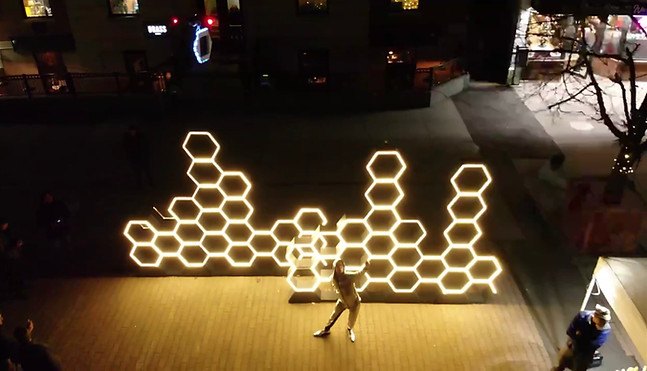
The final project included two robotic drone performances and a dancing performance. The movement of the drones imitated bees building a honeycomb by transporting hexagonal modules.
Drone was commissioned as a public light installation by the City of Somerville, Massachusetts. It stands 10 feet tall and 24 feet wide, built from 48 wooden hexagons and over 350 meters of LED light strips. The structure survived a full New England winter.
Reflection
Public work requires thinking beyond aesthetics. I had to consider structural safety, weather, vandalism, and hundreds of interconnected light circuits. Every choice had to be resilient.


